The Psychology of Proportional Breaks: Why Flowtime 'Feels' Better
Have you ever noticed that a break you earned feels infinitely better than a break you were forced to take? There's real psychology behind that feeling — and it's one of the reasons Flowtime users rep...
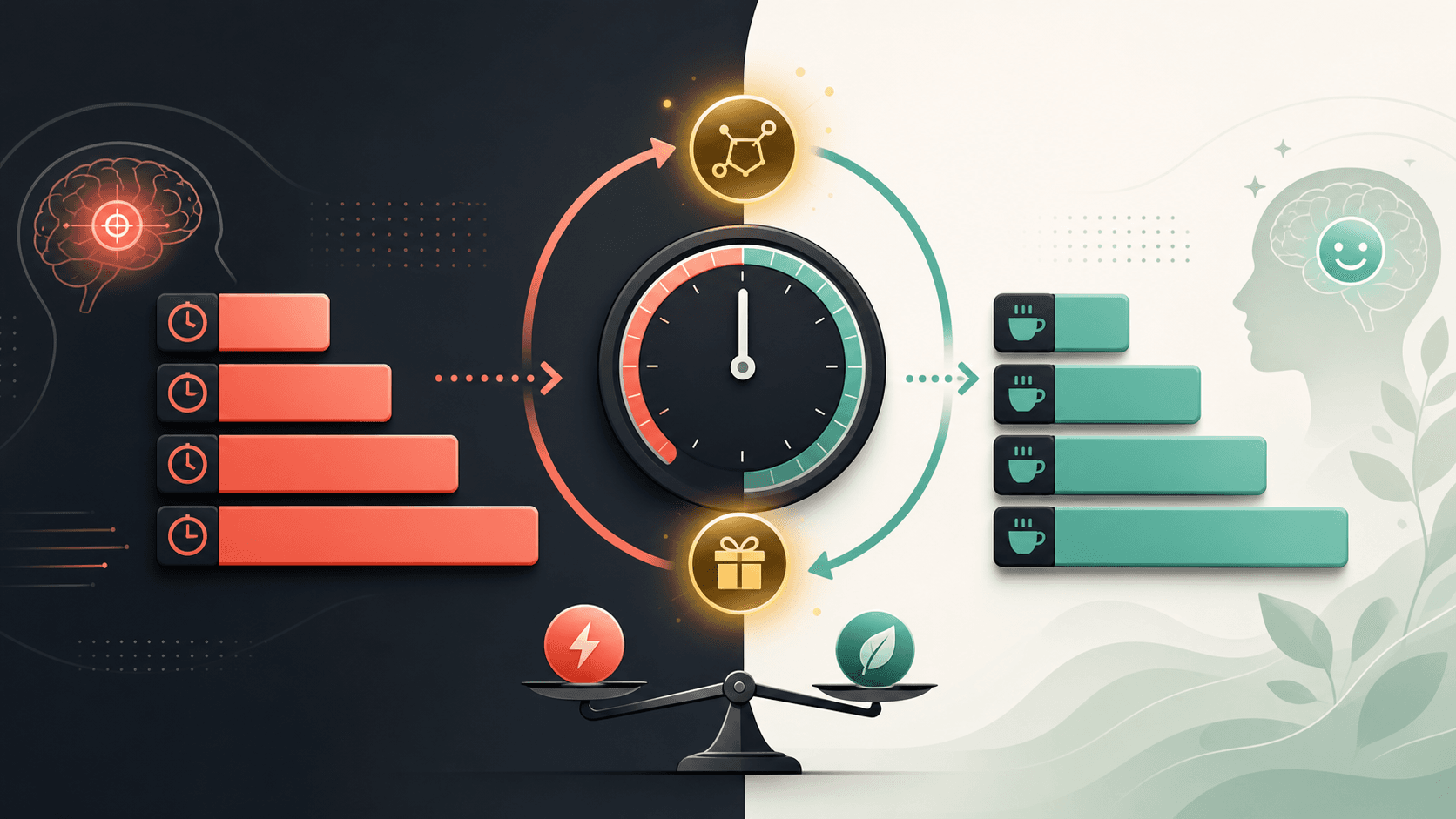
Have you ever noticed that a break you earned feels infinitely better than a break you were forced to take? There's real psychology behind that feeling — and it's one of the reasons Flowtime users report higher satisfaction than users of rigid timer methods.
The Dopamine Reward Loop
Your brain runs on dopamine. It's the neurotransmitter of motivation, reward, and pleasure. When you accomplish something and receive a reward, dopamine releases. This reinforces the behavior and makes you want to do it again.
Here's how this applies to breaks:
Fixed breaks (Pomodoro): You work 25 minutes, timer rings, you take 5 minutes. The break is expected, not earned. It's a scheduled event, not a reward. Dopamine response: minimal.
Proportional breaks (Flowtime): You work 55 minutes, feel your focus fading, stop the timer, and take an 11-minute break. The break is directly tied to your effort. You earned those 11 minutes. Dopamine response: significant.
Over time, this dopamine loop creates a positive association with deep work. Your brain starts to crave focus sessions because it knows a satisfying break is coming.
The Fairness Principle
Humans have a deep sense of fairness. We want our inputs to match our outputs. When you work hard and get a small break, it feels unfair. When you work lightly and get the same break, it feels unearned.
Proportional breaks satisfy the fairness principle:
- Work 20 minutes → 4-minute break (fair)
- Work 60 minutes → 12-minute break (fair)
- Work 90 minutes → 18-minute break (fair)
This fairness isn't just philosophical — it's motivational. When breaks feel fair, you're more likely to take them seriously (no scrolling through Twitter) and return to work refreshed.
The Autonomy Factor
Self-Determination Theory, developed by psychologists Deci and Ryan, identifies three core psychological needs:
- Autonomy: Feeling in control of your actions
- Competence: Feeling capable and effective
- Relatedness: Feeling connected to others
Proportional breaks satisfy autonomy better than fixed breaks because you decide when to stop. You're not obeying a timer — you're listening to your body. This sense of control is intrinsically motivating.
Fixed breaks, by contrast, can feel infantilizing. "The timer says stop, so I must stop." Even when you know it's good for you, the lack of autonomy reduces motivation.
The Sunk Cost Fallacy
Here's a subtle psychological benefit of proportional breaks: they combat the sunk cost fallacy.
When you're 40 minutes into a Pomodoro session and the timer rings, you might think: "But I only have 10 minutes left! I should keep going." So you ignore the timer, work another 25 minutes, and now you've worked 65 minutes with no break. Your focus is shot, but you feel like you "had" to finish.
With Flowtime, there is no preset endpoint. You stop when you need to. There's no "sunk cost" of an unfinished interval because there was no interval to begin with. You simply worked, then rested. Clean. Simple. No guilt.
User Testimonials: The "Feels Better" Effect
Flowtime users consistently report that the app "feels better" than other timers. They can't always articulate why, but the psychology is clear:
- Less frustration: No forced interruptions
- More satisfaction: Breaks feel earned
- Greater control: They decide when to stop
- Better recovery: Proportional rest matches actual fatigue
- Positive reinforcement: The dopamine loop builds over time
The Behavioral Science Backing
Multiple studies support the principles behind proportional breaks:
- Ultradian rhythms: Research shows our bodies operate in 90-120 minute cycles of high and low energy. Proportional breaks align with these natural rhythms better than fixed intervals.
- Effort-recovery model: Meijman and Mulder's research shows that recovery needs are proportional to effort expenditure. More effort = more recovery needed.
- Perceived control: Studies consistently show that perceived control over work conditions reduces stress and increases job satisfaction.
Why This Matters for Long-Term Productivity
Short-term productivity hacks are easy. Long-term sustainable productivity is hard. The psychological satisfaction of proportional breaks isn't just about feeling good today — it's about building a system you'll stick with for years.
Rigid methods feel like diets: restrictive, temporary, and doomed to fail. Adaptive methods feel like lifestyle changes: natural, sustainable, and self-reinforcing.
Flowtime's proportional breaks aren't a feature. They're a philosophy: work hard, rest fairly, and let your brain enjoy the process.
Quick answers
What is the main takeaway from The Psychology of Proportional Breaks: Why Flowtime 'Feels' Better?
Have you ever noticed that a break you earned feels infinitely better than a break you were forced to take? There's real psychology behind that feeling — and it's one of the reasons Flowtime users rep.
How does this relate to Flowtime?
Flowtime helps you apply the idea with an adaptive timer, task tracking, proportional breaks, and analytics that show how your focus sessions actually behave.
Who should use this advice?
Use it if you do focused work, study sessions, creative work, remote work, or task-based work where fixed timers interrupt momentum.