Building a Focus Streak: How to Stay Consistent with Flowtime
Consistency beats intensity. A person who focuses for 60 minutes every day will usually build more reliable momentum than someone who binges for 6 hours once a week. Flowtime's streak tracking helps y...
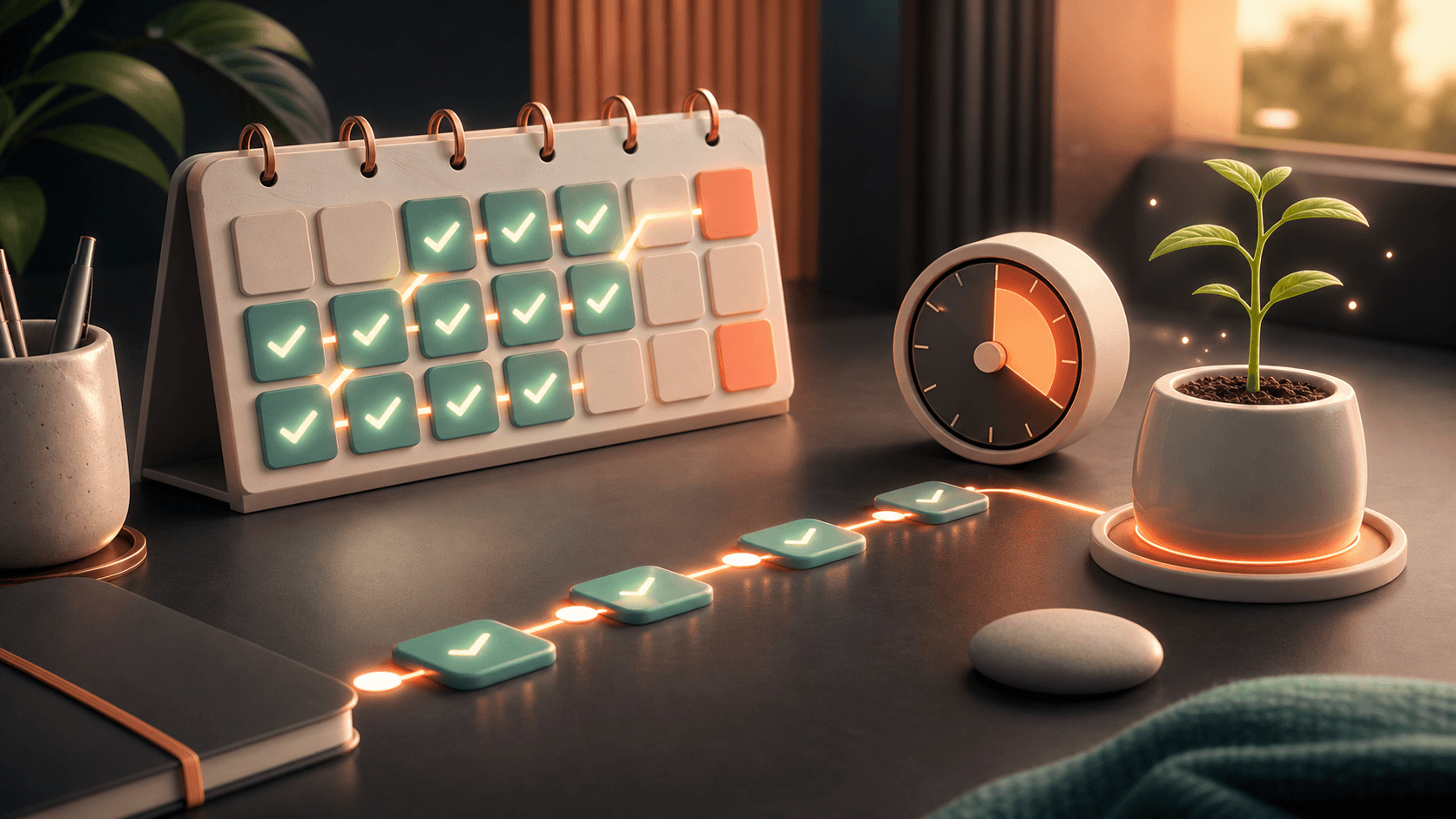
Consistency beats intensity. A person who focuses for 60 minutes every day will usually build more reliable momentum than someone who binges for 6 hours once a week. Flowtime's streak tracking helps you build that consistency one day at a time.
The Psychology of Streaks
Why do streaks work? It's not magic — it's neuroscience. When you complete a daily task and see your streak grow, your brain releases dopamine. This creates a positive feedback loop: the streak motivates you, and your motivation sustains the streak.
Apps like Snapchat, Duolingo, and GitHub have built entire engagement models around this principle. Flowtime brings it to productivity.
How Flowtime Streak Tracking Works
Your streak is the number of consecutive work days where you completed at least one focus session. It is simple, but useful:
- Current streak: How many days in a row you've worked
- Longest streak: Your personal best
- Work-day settings: Which days should count toward your streak
A completed session means you selected a task, started the timer, and logged focused work. The goal is showing up consistently, not forcing every day to become a marathon.
Setting Streak-Friendly Goals
The biggest mistake people make with streaks is setting the bar too high. If your goal is "2 hours of deep work every day," you'll break your streak on busy days, sick days, and travel days. Then you'll feel like a failure and quit.
Better approach: Set a minimum viable session. Examples:
- 15 minutes of focused work
- One completed task
- 25 minutes of learning
These are achievable even on bad days. And once you start, you often keep going.
Flowtime also lets you define which days are work days. If Saturday and Sunday are not part of your focus routine, exclude them so rest does not look like failure. A streak should reinforce the schedule you actually want to keep.
The "Don't Break the Chain" Method
Comedian Jerry Seinfeld famously used a calendar-based streak system for writing jokes. He marked an X on the calendar for every day he wrote. The goal was simple: don't break the chain of X's.
Flowtime handles the tracking for you. Your streak updates from real focus sessions, so you do not need a separate habit calendar just to know whether you showed up.
What to Do When You Break a Streak
You will break your streak. Everyone does. Life happens. The question isn't whether you'll break it — it's what you do next.
Don't:
- Beat yourself up
- Wait until "Monday" or "next month" to restart
- Abandon the system because you "failed"
Do:
- Acknowledge it without judgment
- Restart the next day (or even the same day)
- Analyze why it broke (travel? illness? overwhelm?)
- Adjust your minimum goal if needed
The real metric is not only your longest streak. It is your recovery speed. Someone who breaks a 30-day streak and restarts the next day is more consistent than someone who maintains a 7-day streak but quits for a month after breaking it.
Using Streaks for Different Goals
Flowtime streaks are strongest when they are tied to real sessions and tasks. You can use them for:
- Daily writing: One writing session per day
- Learning: One study session per day
- Specific projects: One session on your side project per day
- Admin cleanup: One short session for email, planning, or maintenance
The key is to choose the task before you start the timer. That gives your streak more meaning because it connects daily consistency with actual work completed.
The Social Aspect
If you want accountability beyond the app, you can create it manually by:
- Sharing your streak screenshots with a friend or accountability partner
- Posting weekly updates on social media
- Competing with yourself: "Can I beat my longest streak?"
Streaks vs. Perfectionism
Streaks can become unhealthy if they turn into pressure. Here's how to keep them motivating:
- Remember the purpose: Streaks build habits, not egos
- Allow flexibility: A "maintenance" session counts even if it's short
- Focus on the present: Today's session matters more than yesterday's streak
- Celebrate milestones: 7 days, 30 days, 100 days — acknowledge your progress
Building Your First Streak
Ready to start? Here's a 7-day plan:
- Day 1: Set your minimum goal (e.g., 15 minutes)
- Day 2: Complete one session, any time of day
- Day 3: Complete a session in the morning
- Day 4: Complete a session and do one break exercise
- Day 5: Complete a session on a task you've been procrastinating
- Day 6: Complete a session and review your analytics
- Day 7: Complete a session and celebrate your week-long streak
At the end of the week, you will have 7 days of consistency, a visible streak, and enough data to understand what helped you keep going. That is how focus habits are built: not through heroic effort, but through daily showing up.
Quick answers
What is the main takeaway from Building a Focus Streak: How to Stay Consistent with Flowtime?
Consistency beats intensity. A person who focuses for 60 minutes every day will usually build more reliable momentum than someone who binges for 6 hours once a week. Flowtime's streak tracking helps y.
How does this relate to Flowtime?
Flowtime helps you apply the idea with an adaptive timer, task tracking, proportional breaks, and analytics that show how your focus sessions actually behave.
Who should use this advice?
Use it if you do focused work, study sessions, creative work, remote work, or task-based work where fixed timers interrupt momentum.